
London is recognized as one of the most linguistically diverse cities on the planet. According to recent census data, residents across the capital’s 32 boroughs speak over 100 different languages, and more than 2.2 million people living in the city were born outside the United Kingdom. This incredible multicultural ecosystem means that cross-lingual communication is a daily necessity for businesses, students, and families.
However, when you need to submit a foreign-language document to an official UK institution, simply speaking the language or running text through a digital translator will not suffice. Official bodies require strict adherence to specific legal standards to ensure accuracy and authenticity. Understanding the specific requirements of these institutions can save you significant time, money, and stress.
This comprehensive guide explains the fundamental differences between certified and regular translations. You will learn exactly how the UK certification process works, which institutions mandate these strict documentation standards, and how to select a professional language partner that guarantees your paperwork will be accepted the first time around.
Defining Regular vs. Certified Translation
At a basic level, all translation involves converting text from a source language into a target language. The divergence happens in the purpose, process, and legal weight of the final document.
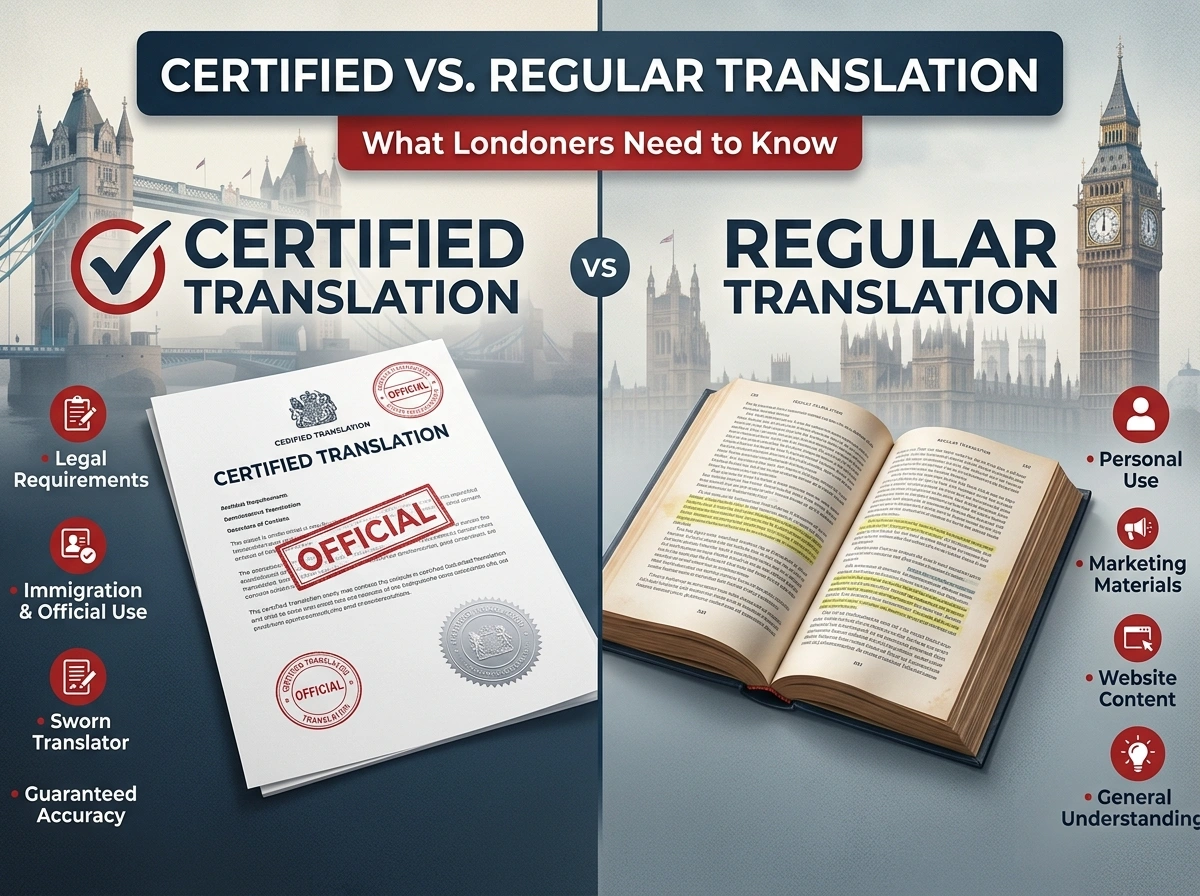
Regular translation is perfectly suited for general use. If a company wants to translate a blog post, a marketing brochure, or an internal staff newsletter, a standard translation is the right choice. The translator focuses on flow, cultural nuance, and readability. There is no need for a formal declaration of accuracy because the text does not serve a legal or official function.
Certified translation represents a much more rigorous process. It is a formal, legally recognized rendering of an official document, such as a birth certificate, marriage license, or academic transcript. A certified translation must be accompanied by a signed statement from the translator or translation agency. This statement confirms that the translation is a true, complete, and accurate representation of the original document. In the UK, this process establishes accountability and ensures that government bodies can trust the translated information.
Key Differences: Legal Validity and Official Recognition
The most significant distinction between these two services is legal validity. A regular translation carries absolutely no legal weight. If you submit a standard translation of a bank statement to a government agency, the agency will treat it as an unverified piece of paper.
Certified translations hold official recognition because they create a paper trail of accountability. When a professional provides a certified document, they are staking their professional reputation and legal liability on its accuracy. Institutions reviewing the document need this assurance to prevent fraud, misrepresentation, or critical misunderstandings. The certification acts as a bridge of trust between the foreign issuing authority and the UK institution receiving the document.
The Certification Process in the UK
Unlike some European countries that use a system of “sworn translators” appointed by courts, the United Kingdom operates under a different framework. In the UK, a certified translation must meet specific criteria set out by government bodies like the Home Office.
To produce a valid certified translation, the translator or agency must provide a formal declaration. This certificate of accuracy must include specific elements:
- A statement confirming that the translation is a “true and accurate translation of the original document.”
- The date of the translation.
- The full name and contact details of the translator or a representative of the translation company.
- A physical or digital signature.
- Details of the translator’s professional credentials or agency memberships.
Without these specific elements, the translation will likely be rejected by UK authorities, regardless of how accurate the actual translated text might be.
When is a Certified Translation Required?
Different institutions have specific thresholds for accepting translated documents. In London, three primary sectors frequently require these formal documents.
The Home Office and UK Visas and Immigration (UKVI)
If you are applying for a UK visa, settling in the country, or seeking citizenship, the Home Office requires extensive documentation. UKVI mandates that any supporting evidence not originally written in English or Welsh must be accompanied by a certified translation. This includes birth certificates, marriage certificates, police clearance checks, and financial records. The Home Office has zero tolerance for improperly formatted translations, and a mistake here can lead to a visa rejection and the loss of expensive application fees.
Courts and Tribunals
The UK legal system relies on precise evidence. If you are involved in proceedings at the Royal Courts of Justice, the Old Bailey, or an immigration tribunal, foreign-language evidence must be certified. Judges and solicitors need absolute certainty that the translated emails, contracts, or witness statements reflect the exact meaning of the original files.
Universities and Academic Institutions
London is home to world-renowned academic institutions like UCL, Imperial College, the London School of Economics (LSE), and King’s College London. When international students apply to these universities, admissions departments require certified translations of foreign academic transcripts, degree diplomas, and grading rubrics. This allows the university to accurately assess the applicant’s educational background against UK standards.
Why London-Based Services Offer a Distinct Advantage
Navigating the bureaucratic landscape of the UK capital requires localized expertise. Choosing certified translation services london provides individuals and businesses with several distinct advantages.
Local providers understand the specific nuances of the city’s institutions. They know exactly what the admissions office at Queen Mary University expects to see, and they are familiar with the exact formatting preferred by the immigration tribunals in Hatton Garden. Furthermore, proximity matters when dealing with physical documents. If you need to combine a certified translation with an Apostille for international use via the Foreign, Commonwealth & Development Office (FCDO), a centrally located agency can expedite the process significantly.
Quality Standards and Professional Bodies
The unregulated nature of the UK translation industry means that anyone can technically call themselves a translator. To protect yourself, you must look for professionals aligned with recognized industry bodies.
The most prominent organizations include the Institute of Translation and Interpreting (ITI), the Chartered Institute of Linguists (CIOL), and the Association of Translation Companies (ATC). Members of these organizations must pass rigorous assessments and adhere to strict codes of professional conduct. When an agency or linguist holds these credentials, their certified translations carry a much higher degree of authority and are universally accepted by UK government departments.
Common Pitfalls of Using Regular Translations for Official Use
Attempting to cut corners with official documentation frequently leads to disastrous results. Many individuals try to save money by using regular translation methods for legal documents, only to face severe consequences.
Using automated software or artificial intelligence to translate a legal contract often results in critical contextual errors. Likewise, asking a bilingual friend or family member to translate a birth certificate is a major mistake. The Home Office explicitly forbids applicants from submitting translations completed by themselves or their relatives, due to the obvious conflict of interest.
If you submit a non-certified translation, the receiving authority will reject your application. This triggers significant delays, forces you to restart the entire process, and often results in forfeited application fees. In immigration cases, a rejected document can even jeopardize your legal status in the country.
How to Choose the Right Certified Translation Provider
Selecting a reliable language partner is a critical step in your application or legal process. You should evaluate potential agencies based on a few key criteria.
First, verify their experience with the specific institution you are applying to. An agency that routinely handles UKVI submissions will automatically include the correct certification statements. Second, check their security protocols. You are handing over highly sensitive personal data, such as bank statements and passports. The provider must use secure, encrypted portals and comply with UK GDPR regulations.
Finally, demand transparency regarding pricing and turnaround times. Reputable agencies usually charge per page or per word for standard documents and will provide a clear, upfront quote without hidden fees.
Securing the Right Translation for Your Official Documents
Handling official paperwork is rarely an enjoyable experience, but securing the correct type of translation does not have to be a major hurdle. Understanding the strict boundary between general language services and certified translations empowers you to make the right choices for your specific needs. By prioritizing professional credentials, local expertise, and strict compliance with UK regulations, you can ensure your applications proceed smoothly and without unnecessary delays.
Always take the time to verify the requirements of the institution you are applying to, and partner with a recognized professional who can deliver a flawless, legally sound translation.

