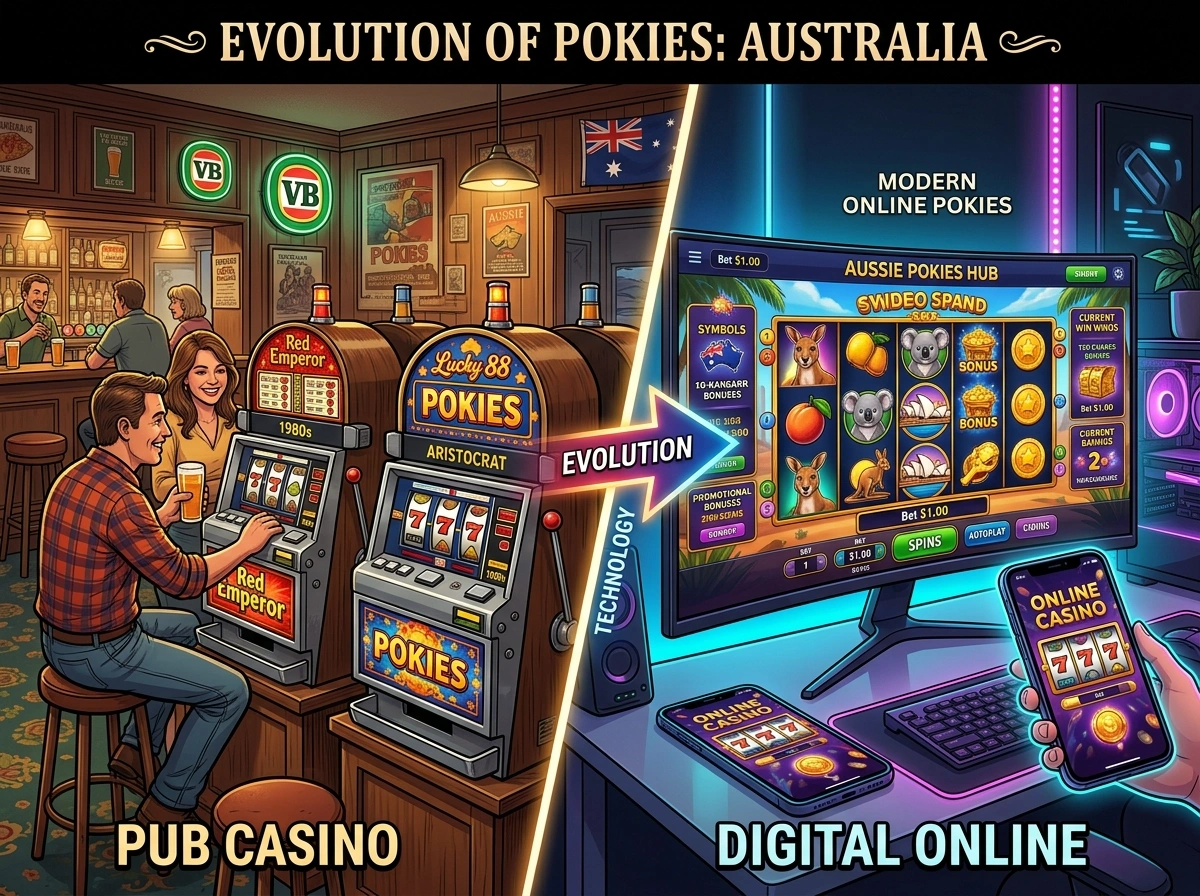
Few games are as woven into Australian culture as the humble pokie. Whether you have spent an evening at the local club or simply walked past a row of glowing machines, pokies are part of the national fabric. But how did these spinning reels become such a fixture? Their story stretches back more than a century and crosses oceans, technology shifts, and decades of changing laws. Let’s trace that journey from clunky mechanical boxes to the digital screens we tap today.
Where It All Began: The Birth of the Slot Machine
The earliest ancestor of the modern pokie appeared in the United States during the late 1800s. In 1894, a San Francisco mechanic named Charles Fey built a machine he called the Liberty Bell. It featured three reels, a handful of symbols, and an automatic payout system. Pull the lever, line up three bells, and you walked away with a small prize.
This invention was revolutionary. Earlier gambling machines required a bartender or attendant to hand over winnings. Fey’s design did it all on its own. The Liberty Bell spread quickly through bars and saloons, setting the template for everything that followed.
The classic fruit symbols many of us still recognise also came from this era. When gambling laws tightened in parts of America, manufacturers rebranded their machines as gum dispensers. The cherries, lemons, and plums hinted at the flavour you might “win.” The symbols stuck around long after the gum disappeared.
How Pokies Arrived in Australia
Australians took to the machines with real enthusiasm, though the path was not always smooth. For much of the early twentieth century, the legal status of these devices was murky and varied from state to state.
The turning point came in 1956. New South Wales became the first place in Australia, and one of the first in the world, to legalise poker machines in registered clubs. The decision was partly practical. Clubs were already running illegal machines, and the government saw a chance to regulate the activity and collect revenue at the same time.
The word “pokie” itself is a uniquely Australian shortening of “poker machine.” Over time it became the everyday term, and it remains the go-to expression across the country today.
The Rise of Clubs and Pubs
Once legalised, pokies transformed the social landscape. Registered clubs used the income to build bigger venues, fund sporting teams, and offer cheaper meals and drinks to members. The machines became a reliable money-maker, and the clubs became community hubs.
For decades, NSW held a near-monopoly on legal pokies. Other states watched the revenue flowing into club coffers and gradually followed suit. By the 1990s, most Australian states and territories had legalised the machines in pubs, clubs, or casinos. Each jurisdiction set its own rules about how many machines a venue could hold and how they could operate.
Key Regulatory Milestones
The history of pokies is also a history of regulation. As the machines became more popular, governments faced pressure to balance revenue against community concerns.
Some of the most important developments include:
- State licensing systems. Each state created its own framework for approving machines, capping numbers, and taxing profits.
- The spread beyond NSW. Victoria, Queensland, South Australia, and others legalised pokies through the late 1980s and 1990s.
- Responsible gambling measures. From the early 2000s onward, governments introduced limits on bet sizes, mandatory signage, self-exclusion programs, and restrictions on operating hours.
- The Productivity Commission reviews. National inquiries examined the social cost of gambling and recommended reforms, shaping ongoing policy debates.
These measures reflect a constant tension. Pokies generate enormous tax revenue and support many community organisations, yet they also raise genuine concerns about problem gambling. That balancing act continues to drive policy today.
From Mechanical Reels to Digital Screens
While laws evolved, so did the technology inside the machines. The shift was dramatic.
The original pokies were fully mechanical. Spinning reels, physical springs, and metal payout mechanisms did all the work. Your odds were fixed by the number of symbols on each reel, and the experience was simple.
The 1960s and 1970s brought electromechanical machines. These combined moving parts with electrical components, allowing for flashing lights, sounds, and slightly more complex payouts.
The real leap came with video technology. By the 1980s, manufacturers began replacing physical reels with screens. These video pokies could display more reels, more pay lines, and elaborate bonus features. A single machine could now host dozens of different games. Random number generators replaced mechanical chance, ensuring each spin was independent and unpredictable.
This digital foundation set the stage for the next great shift: moving the game off the venue floor entirely.
The Emergence of Online Pokies in Australia
The internet changed almost every form of entertainment, and gambling was no exception. As home computers and fast connections became common in the late 1990s and 2000s, the first online casino games appeared. Suddenly, players could spin a reel from their living room rather than driving to a club.
Online versions offered clear advantages. They removed travel time, ran around the clock, and gave developers freedom to design games unconstrained by physical hardware. Themes exploded in variety, from ancient mythology to blockbuster films, and bonus rounds grew more creative.
The legal picture in Australia is layered. The Interactive Gambling Act of 2001 set the rules for online wagering and continues to shape what operators can offer. For players curious about the modern landscape and how the digital game has developed, resources dedicated to online pokies australia offer a closer look at the current scene. As always, anyone choosing to play should understand the rules that apply in their state or territory and gamble responsibly.
Mobile technology accelerated everything. Smartphones put a full casino in every pocket. Touchscreens replaced levers and buttons, and games were redesigned for smaller displays. Today, a player can enjoy hundreds of titles on a device that fits in their palm, something Charles Fey could never have imagined when he built the Liberty Bell.
What Made Pokies So Popular
It is worth pausing to ask why pokies captured the Australian imagination so completely. A few factors stand out.
First, they are easy to play. There is no skill barrier, no complex rules to learn. Anyone can sit down and spin.
Second, the experience is sensory and rewarding. Lights, sounds, and near-misses keep players engaged. Designers have spent decades refining this feedback loop.
Third, accessibility played a huge role. With machines in thousands of clubs and pubs, pokies were never far away. The move online only widened that reach.
Looking to the Future
The story of pokies is far from finished. Technology keeps pushing the game in new directions. We are already seeing experiments with virtual reality, more sophisticated graphics, and tighter integration with mobile platforms.
At the same time, conversations about responsible gambling are growing louder. Future reforms may bring stronger player protections, clearer spending limits, and better tools to help people stay in control. The challenge of balancing entertainment, revenue, and community welfare will remain central.
From a mechanical box in a San Francisco saloon to a sleek app on your phone, pokies have travelled an extraordinary distance. They reflect over a century of invention, shifting laws, and changing tastes. Whatever comes next, one thing seems certain: the spinning reel, in some form, will keep turning for generations to come.
