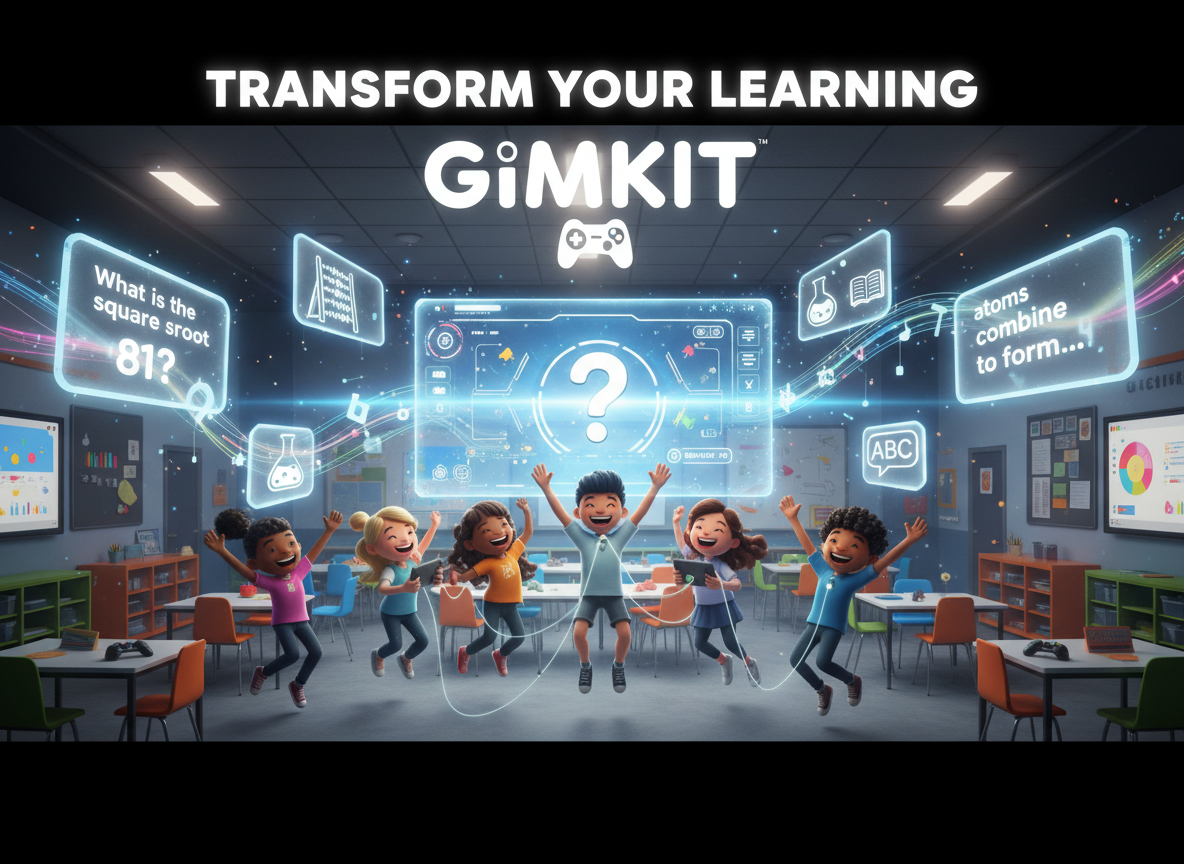
Getting students excited about review sessions used to be one of the toughest challenges in the classroom. The sound of groans when a teacher announced a quiz review was all too familiar. But today, classrooms buzz with a different energy. Students are shouting out answers, collaborating in teams, and actively asking to play “just one more round.” The reason for this shift? A game-show-inspired platform called Gimkit.
Unlike traditional quiz tools that simply digitize a worksheet, Gimkit fundamentally changes the mechanics of how students interact with content. It merges high-stakes strategy with academic review, creating an environment where knowledge is the currency. This article explores how Gimkit is redefining student engagement, the specific mechanics that drive motivation, and why it has become a staple in modern classrooms.
The Evolution of Gamified Learning
Educational technology has come a long way from simple “drill and kill” flashcard apps. Early iterations of ed-tech focused on efficiency—grading faster or distributing content easier. However, efficiency doesn’t always equal engagement.
Gimkit was created by a high school student, Josh Feinsilber, who understood exactly what was missing from existing platforms. He realized that points on a screen weren’t enough. Students needed agency, strategy, and a sense of progression.
More Than Just Right Answers
Most quiz games follow a linear path: answer a question, get points, see a leaderboard. Gimkit disrupts this flow. When students answer questions correctly, they earn in-game virtual currency. This simple twist changes everything.
Students must decide how to use their earnings. Do they reinvest in upgrades that multiply their points per question? Do they buy insurance to protect against wrong answers? Or do they purchase power-ups to hinder the leading team? This layer of economic strategy forces students to think critically not just about the subject matter, but about their gameplay approach.
Key Features Driving Engagement
Gimkit’s success lies in its diverse game modes and constant updates. It keeps the experience fresh so that the novelty doesn’t wear off after a few sessions.
1. The Power of Upgrades
The shop feature is the heart of Gimkit’s engagement model. It introduces a concept familiar to anyone who plays video games: the “grind” for better gear. Students answer questions rapidly to afford a “Streak Bonus” or a “Multiplier.” This creates a positive feedback loop. To get better at the game, you must answer more academic questions. The desire to upgrade drives the repetition needed for mastery.
2. Diverse Game Modes
One day, a class might play “The Floor is Lava,” where everyone must work together to keep the group above water (or lava). The next day, they might play “Trust No One,” a deduction game inspired by Among Us, where students must identify the impostors while answering questions.
- Classic Mode: Individual competition to earn the most money.
- Team Mode: Collaborative efforts where earnings are pooled.
- Infinity Mode: The game continues until a specific financial goal is reached by the class.
- Fishtopia: A virtual world where students catch fish and sell them, blending exploration with quizzing.
3. KitCollab
Teachers often struggle to create fresh content. KitCollab allows students to build the quiz themselves. Each student submits a question, and the teacher approves or rejects it in real-time. The game then consists of the questions the class just created. This promotes ownership over learning. When a student sees their own question pop up on the screen, their investment in the activity skyrockets.
Fostering Collaboration and Critical Thinking
While competition is a strong motivator, Gimkit shines brightest when it facilitates teamwork. Many game modes are impossible to win alone.
Strategic Teamwork
In team modes, students quickly realize they need roles. You might see one student designated as the “earner,” focusing solely on answering questions rapidly to generate cash. Another student might be the “buyer,” managing the team’s upgrades to maximize efficiency. A third might be the “defender,” using power-ups to shield the team from opponents.
This organic role-assignment mimics real-world collaboration. Students aren’t just memorizing facts; they are communicating, negotiating, and executing a shared strategy under time pressure.
Critical Decision Making
Consider a scenario where a student has earned $500 in the game. They face a choice:
- Buy a multiplier now to earn cash faster?
- Save up for a massive bonus later?
- Sabotage the leading player who is $2,000 ahead?
This isn’t just about knowing the capital of France or the atomic weight of Gold. It’s about risk assessment and resource management. These are higher-order thinking skills being exercised in the background of a simple vocabulary review.
Real-World Scenarios: Gimkit in Action
To understand the impact, we need to look at how teachers are deploying this tool across different subjects and grade levels.
The Foreign Language Classroom
In a Spanish II class, vocabulary retention is a constant battle. A teacher uses Gimkit’s “Draw That” mode. One student sees a vocabulary word and must draw it on their device while the others guess. It forces the drawer to recall the meaning visually and the guessers to recall the word from the image. It transforms rote memorization into a Pictionary-style party game.
The Math Review
A middle school math teacher notices that students give up easily when solving multi-step equations. She sets up a session of “Humans vs. Zombies.” If the zombies (students who answer incorrectly or are tagged) catch the humans, the humans turn into zombies. The only way to survive is to answer questions correctly to build defenses. The urgency of the game motivates students to work through complex problems they might otherwise skip on a worksheet.
Professional Development
It’s not just for kids. Administrators are using Gimkit during staff meetings to review new policies or handbook updates. Instead of a boring slide deck, teachers play a quick 5-minute round. It wakes everyone up, builds camaraderie, and ensures the information is actually read and processed.
Benefits Beyond the Screen
The advantages of using Gimkit extend beyond the immediate fun of the game.
1. Safe Failure
In a traditional quiz, a wrong answer is a red mark. In Gimkit, a wrong answer just costs you a bit of virtual money or time. You can immediately try again. This low-stakes environment encourages students to take risks and learn from their mistakes without the fear of permanent academic penalty.
2. Data-Driven Instruction
While students play, Gimkit collects data. Teachers receive detailed reports showing exactly which questions were missed the most. This allows for immediate intervention. A teacher can stop the game, pull up the data, and say, “I see 60% of us missed the question about photosynthesis. Let’s review that concept right now before we continue.”
3. Accessibility and Inclusion
Gimkit includes features like “Immersive Reader” from Microsoft, which can read questions aloud for students with reading difficulties or visual impairments. The repetitive nature of the game also supports students who need extra processing time, as questions cycle back around, giving them multiple opportunities to succeed.
The Future of Gamified Learning Tools
Gimkit represents a maturity in the gamification of education. It proves that learning tools don’t have to choose between being educational or being entertaining—they can be both.
As we look forward, tools like Gimkit will likely integrate even more adaptive learning technologies. Imagine a version of Gimkit where the difficulty of the questions adjusts automatically based on the student’s in-game performance, ensuring they are always in the “zone of proximal development.”
The platform also highlights a shift in the role of the teacher. The teacher moves from being the “sage on the stage” delivering content, to the “guide on the side” facilitating an experience. This shift is crucial for modern pedagogy, where student-centered learning is the goal.
Conclusion
Gimkit transforms learning by acknowledging a simple truth: students learn best when they are active participants. By layering economic strategy, teamwork, and high-energy game modes over academic content, it turns passive review into an active pursuit of mastery.
For educators looking to revitalize their classroom, Gimkit offers a solution that appeals to the digital native student. It builds a classroom culture where knowledge is power—literally. As educational technology continues to evolve, platforms that prioritize student agency and engagement will continue to lead the way.
Ready to transform your classroom? Start by signing up for a free account, explore the “featured” game modes, and challenge your students to a battle of wits and strategy. You might just find that they ask to stay in class a few minutes longer to finish the round.
Please click here for more info
